Thailand, Cambodia and
Vietnam were short listed for our summer vacation and as usual all booking and
arrangements were done by Ranjan in no time.
18 to 20th
June 2015: Bangkok:


Kids were already there
at Bangkok with their cousin Ranjan.
Arpit was doing internship at American Red Cross and younger Kshitij was
taking lessons from brother. We joined
them on 18th morning. It was
my forth visit to Bangkok. Therefore, the idea was to see something new.
Bangkok offers vast
opportunity to explore new things. This
time we opted for Siam Niramit. Siam
Niramit can be described as exhibition cum show of Thai’s rich cultural
heritage. The group folk dances, village
environment, handi craft making, village cooking and rituals are all well
displayed at this centre. It uses special techniques integrated with
drama to depict the history of each region of Thailand including depictions of
hell, the forest of Himmaphan, heavens, and lands beyond imagination from Thai
literature. There is also a spectacular performance of Thailand's arts and
cultural heritage. The show is staged by more than 150 performers in a
luxurious theater with a capacity of more than 2,000 seats.

 We also took
opportunity to visit new IKEA store. It
is a huge store created in around 1.5 lacs sqft of space and you have everything which
you can think for your house. They
suggest very standard design of furnishing.
You simply select the design and IKEA people will create samething at
your door step.
We also took
opportunity to visit new IKEA store. It
is a huge store created in around 1.5 lacs sqft of space and you have everything which
you can think for your house. They
suggest very standard design of furnishing.
You simply select the design and IKEA people will create samething at
your door step.
Another location worth
mentioning is Mall-21 Terminal, a place which always fascinates us.

In the afternoon we all went to see the floating village. The boat negotiates through a shallow muddy river for about 45 minutes to takes us to middle of the lake and where you can see village life in midst of water. We being vegetarian could only drink coconut water and nothing else was meant for us.


 The next day morning,
we went to Angkor wat (temple) at around 5 am to see the first glimpse of
temple in Lake with rising sun. The
morning ambiance was awesome. These
temples were built in the 12th Century by King Suryavarman and have gone
through many turmoil over last 900
years. These temples are proof that Hinduism spread not only in India but
other part of east Asia and they left indelible mark for ever. Angkor
Wat (Wat temple) is the central feature of the
Angkor UNESCO World Heritage Site containing the magnificent remains of the Khmer civilization. Thousands of feet of wall space are
covered with intricate carving depicting scenes from Hindu mythology including
Ramayana. I feel international tourists
come to Siam Reap mainly to see the glimpse of Angkor Wat.
The next day morning,
we went to Angkor wat (temple) at around 5 am to see the first glimpse of
temple in Lake with rising sun. The
morning ambiance was awesome. These
temples were built in the 12th Century by King Suryavarman and have gone
through many turmoil over last 900
years. These temples are proof that Hinduism spread not only in India but
other part of east Asia and they left indelible mark for ever. Angkor
Wat (Wat temple) is the central feature of the
Angkor UNESCO World Heritage Site containing the magnificent remains of the Khmer civilization. Thousands of feet of wall space are
covered with intricate carving depicting scenes from Hindu mythology including
Ramayana. I feel international tourists
come to Siam Reap mainly to see the glimpse of Angkor Wat.
21st June
was International Yoga Day and our women folk Beenu and Anju joined the yoga
group near temple site attended by a few hundred people.

Despite weather being hot and humid, we went to Cambodian Cultural Village in the afternoon. Though the village offers full day
programmes, we went to a Theatre where
Show of Cambodian traditional Marriage was in progress. The show was magnificent with both bride and
bridegroom looked like real and all rituals were performed in the presence of
parents of bride (of course parents were chosen from among the audience only). Opened on September 24, 2003, this village assembles all
the miniatures of famous historical buildings and structures of Cambodia. There
are 11 unique villages, which represent different culture heritages, local
customs and characteristics of 21 multi races.
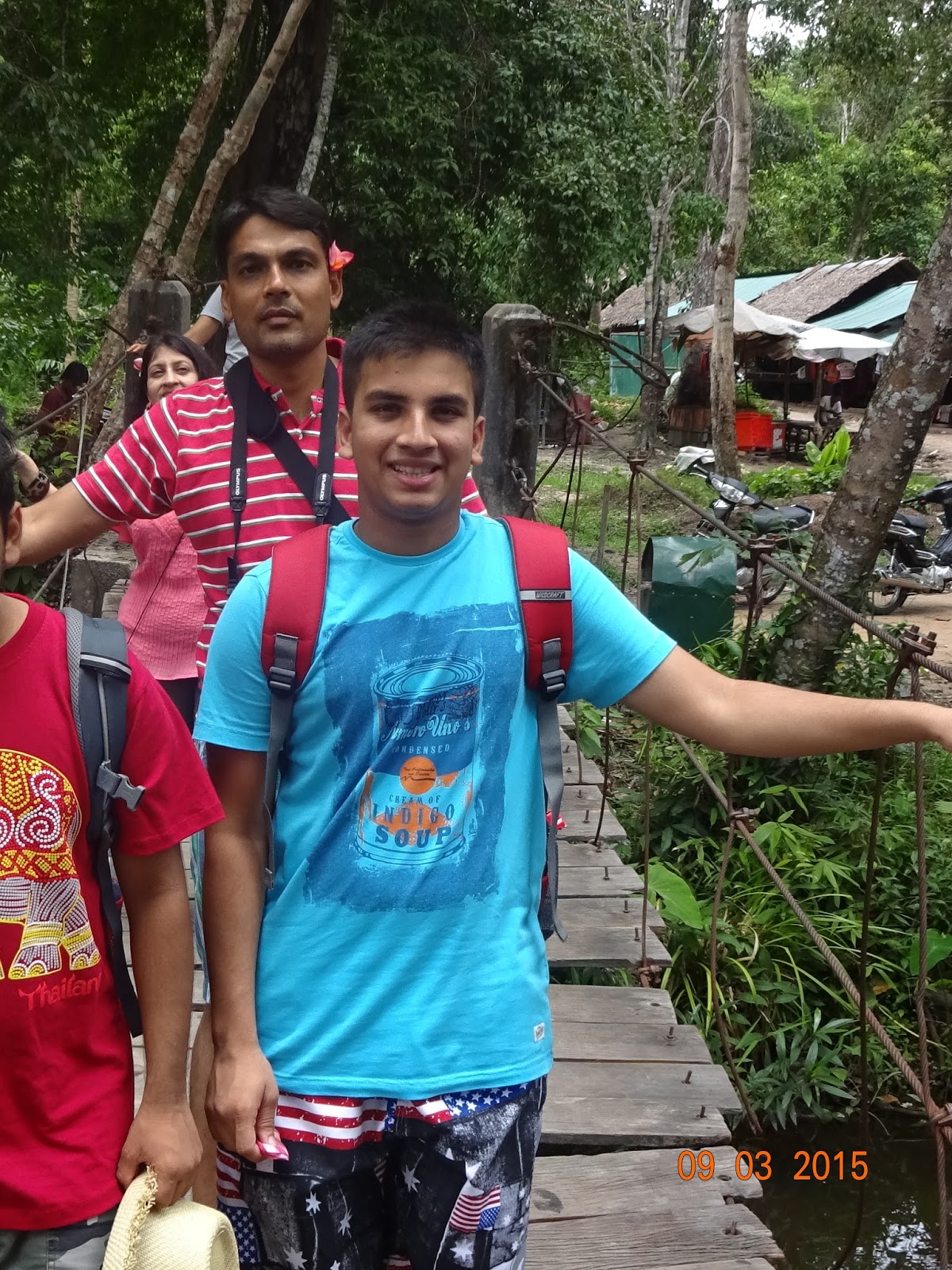
 On 22nd morning, we planned for visit to an ancient village
called Kulen where thousands of Shivlingam are carved on stone in the flowing
river. Besides this, one could enjoy the
mesmerizing bath and natural massages from water falls. The river negotiates through deep ravines and
forest but we were not allowed to go beyond a point as our guide told us that
there are still unexploded mines there
in that area. This is part of Phnom Kulen National Park and is about 48 km from Siem Reap.
On 22nd morning, we planned for visit to an ancient village
called Kulen where thousands of Shivlingam are carved on stone in the flowing
river. Besides this, one could enjoy the
mesmerizing bath and natural massages from water falls. The river negotiates through deep ravines and
forest but we were not allowed to go beyond a point as our guide told us that
there are still unexploded mines there
in that area. This is part of Phnom Kulen National Park and is about 48 km from Siem Reap. 
 Phnom Pehn is a
relatively modern city and is famous of its Russian Market and Genocide
Museum. Thousands of Skeltons of men,
women and children are housed here which tell us horrifying stories of
atrocities committed by Khmer Rouge on
their fellow countrymen during 1975 to 1979.
During Khmer Rouge regime,
all of its residents, including those
who were wealthy and educated, were evacuated from the city and forced to do
labour on rural farms as "new people". Tuol Sleng High School was taken over by Pol Pot's forces and was turned into the S-21 prison camp, where people were detained and tortured. Pol Pot sought a
return to an agrarian economy and therefore killed many people perceived as
educated, "lazy", or political enemies. Choeung Ek (The Killing Fields),
15 kilometers away, where the Khmer
Rouge marched prisoners from Tuol Sleng to be murdered and buried in shallow
pits, is also now a memorial to those who were killed by the regime. The Khmer Rouge were driven out of Phnom Penh by the Vietnamese in 1979 and people
began to return to the city.
Phnom Pehn is a
relatively modern city and is famous of its Russian Market and Genocide
Museum. Thousands of Skeltons of men,
women and children are housed here which tell us horrifying stories of
atrocities committed by Khmer Rouge on
their fellow countrymen during 1975 to 1979.
During Khmer Rouge regime,
all of its residents, including those
who were wealthy and educated, were evacuated from the city and forced to do
labour on rural farms as "new people". Tuol Sleng High School was taken over by Pol Pot's forces and was turned into the S-21 prison camp, where people were detained and tortured. Pol Pot sought a
return to an agrarian economy and therefore killed many people perceived as
educated, "lazy", or political enemies. Choeung Ek (The Killing Fields),
15 kilometers away, where the Khmer
Rouge marched prisoners from Tuol Sleng to be murdered and buried in shallow
pits, is also now a memorial to those who were killed by the regime. The Khmer Rouge were driven out of Phnom Penh by the Vietnamese in 1979 and people
began to return to the city.
 One of the most popular areas in Phnom Penh for tourists is Sisowath Quay, alongside the Tonle Sap River. Sisowath Quay is a
3-mile strip of road that includes restaurants, bars, and hotels.
One of the most popular areas in Phnom Penh for tourists is Sisowath Quay, alongside the Tonle Sap River. Sisowath Quay is a
3-mile strip of road that includes restaurants, bars, and hotels.
We stayed here at Hotel
Queen. Yes, we enjoyed our morning and
evening walk at War Memorial and at the bank of river Mekong. The Mekong is a trans-boundary river in
South East Asia and runs through China, Mynmar, Laos, Thailand, Cambodia and
Vietnam.
On 24th
morning, we took bus and set for Vietnam.
Though the distance between Phnopehn and Ho Chi Minh city is hardly 287
km, it takes nearly 8 hours to reach as bus runs on a regulated speed and also
they keep a margin of two hours for immigration clearance at the border of
Vietnam.
 Ho Chi Minh city was
earlier known as Saigon City, but renamed after the first leader of North Vietnam
Ho Chi Minh. It is a metro
city having population of around 15 million.
We had our stay arrangement at Somerset Serviced Apartments. This
city was earlier part of South Vietnam and has seen much of the action. America was ally of South Vietnam and continuously
fought with North Vietnam for over 20 years and finally back tracked without
any result. The important feature of
this war is that USA used extensively chemical war fare, while it always preach
the world war without chemical weapons. The capture
of Saigon by the North Vietnamese Army
in April 1975 marked the end of the war, and North and South Vietnam were
reunified the following year. It is
estimated that around 3 million people lost their lives in this bloody war.
Ho Chi Minh city was
earlier known as Saigon City, but renamed after the first leader of North Vietnam
Ho Chi Minh. It is a metro
city having population of around 15 million.
We had our stay arrangement at Somerset Serviced Apartments. This
city was earlier part of South Vietnam and has seen much of the action. America was ally of South Vietnam and continuously
fought with North Vietnam for over 20 years and finally back tracked without
any result. The important feature of
this war is that USA used extensively chemical war fare, while it always preach
the world war without chemical weapons. The capture
of Saigon by the North Vietnamese Army
in April 1975 marked the end of the war, and North and South Vietnam were
reunified the following year. It is
estimated that around 3 million people lost their lives in this bloody war.
Today, the city's core is still
adorned with wide elegant boulevards and historic French colonial buildings.
The majority of these tourist spots are located in District 1 and are a short
leisurely distance from each other. The most prominent structures in the city centre
are the Reunification Palace, City Hall, Municipal Theatre also known as the Opera House, City Post Office, State Bank Office, and Notre-Dame
Cathedral.

 The city has various museums
including the Ho Chi Minh City Museum, Museum of
Vietnamese History, the
Revolutionary Museum, the Museum of Southeastern Armed Forces, the War Remnants Museum, the Museum of Southern Women,
the Museum of Fine Art, the Nha Rong Memorial House, and the Ben Duoc Relic of
Underground Tunnels. The Củ Chi tunnels are northwest of the city
in Củ Chi District.
The city has various museums
including the Ho Chi Minh City Museum, Museum of
Vietnamese History, the
Revolutionary Museum, the Museum of Southeastern Armed Forces, the War Remnants Museum, the Museum of Southern Women,
the Museum of Fine Art, the Nha Rong Memorial House, and the Ben Duoc Relic of
Underground Tunnels. The Củ Chi tunnels are northwest of the city
in Củ Chi District.
Backpacking
travelers most often frequent the "Western Quarter" on District
1.
 The night freak out is
very special in this city. The Central
city is totally illuminated with modern shopping complexes and star
hotels. The morning walk was very
special near Siagon River. The city
Admnistration has created open Gym for the benefit of people. One can see old and young alike working out
at the park.
The night freak out is
very special in this city. The Central
city is totally illuminated with modern shopping complexes and star
hotels. The morning walk was very
special near Siagon River. The city
Admnistration has created open Gym for the benefit of people. One can see old and young alike working out
at the park. One day was planned for
tour to Cu Chi Tunnels. These tunnels
are located around 60 km from Ho Chin Min City. During Vietnam War people created tunnel in
jungle to escape from the American atrocities.
The tunnels are very very narrow and at a time only one person can crawl
in the cave. However, at different locations they made provisions
for Kitchens, medical care, sleeping rooms and other facility. The tunnels were designed in such a way that
enemy couldn’t dare to enter into it.
However, American spread millions of litres Chemical in this area,
making the whole vegetation poisonous.
One day was planned for
tour to Cu Chi Tunnels. These tunnels
are located around 60 km from Ho Chin Min City. During Vietnam War people created tunnel in
jungle to escape from the American atrocities.
The tunnels are very very narrow and at a time only one person can crawl
in the cave. However, at different locations they made provisions
for Kitchens, medical care, sleeping rooms and other facility. The tunnels were designed in such a way that
enemy couldn’t dare to enter into it.
However, American spread millions of litres Chemical in this area,
making the whole vegetation poisonous.
Our next destination
was Hanoi, the capital of Vietnam. We flew from Ho Chi Minh city to Hanoi on 27th
June by Air Vietnam and stayed at Hotel Sun Vill in Old Quarter Area.

 Hanoi
is located in northern region of Vietnam, situated in the Vietnam’s Red River
delta, nearly 90 km away from the
coastal area. Hanoi contains three basic kind of terrain, which are the delta
area, the midland area and mountainous zone. As the capital of Vietnam for
almost a thousand years, Hanoi is considered one of the main cultural centres
of Vietnam, where most Vietnamese dynasties have left their imprint.
Hanoi
is located in northern region of Vietnam, situated in the Vietnam’s Red River
delta, nearly 90 km away from the
coastal area. Hanoi contains three basic kind of terrain, which are the delta
area, the midland area and mountainous zone. As the capital of Vietnam for
almost a thousand years, Hanoi is considered one of the main cultural centres
of Vietnam, where most Vietnamese dynasties have left their imprint.
 Hoan
Keim lake and its surrounding of Shopping Complexes, restaurants, hotels is a
major place of tourist attraction. During
morning the place is crowded by the health conscious locals as well as
tourists. And in the evening this is one
of the most happening areas where lot of music, dances, and cultural events remain
in vogue. Happiness on the face of
general Viatnami is very usual here. And
if you want to see something more, go to Water Puppet Show. We spent most of our time in this area. Even the night market is at a walking
distance.
Hoan
Keim lake and its surrounding of Shopping Complexes, restaurants, hotels is a
major place of tourist attraction. During
morning the place is crowded by the health conscious locals as well as
tourists. And in the evening this is one
of the most happening areas where lot of music, dances, and cultural events remain
in vogue. Happiness on the face of
general Viatnami is very usual here. And
if you want to see something more, go to Water Puppet Show. We spent most of our time in this area. Even the night market is at a walking
distance. 


 The Lake Garden and
Central Market were just at walking distance from our Hotel Sun Villa, a very
beautiful boutique hotel. We were
initially sceptical about the quality of service in the hotel, but we were
amazed at the hospitality of the hotel staff.
They were simply superb.
The Lake Garden and
Central Market were just at walking distance from our Hotel Sun Villa, a very
beautiful boutique hotel. We were
initially sceptical about the quality of service in the hotel, but we were
amazed at the hospitality of the hotel staff.
They were simply superb.
On 28th morning, we moved out to see the ancient
capital of Hoa Lư which located in a flat valley between small but steep
limestone mountains that created virtually impenetrable barriers to human
traffic. Even today, many of the mountains are accessible only to the mountain
goats that roam the area. The
boat ride in the river while crossing huge caves in between the major part of
our excitement. We also took opportunity
to have cycle tour of village near Hoa Lu interspersed between line stone
mountains and rocks.
We planned one day Cruise
stay and to see Halong Bay, a world heritage site. We booked Bhaiya Cruise and alongwith other
co travellers, we headed for Halong Bay on 30th June, 2015.
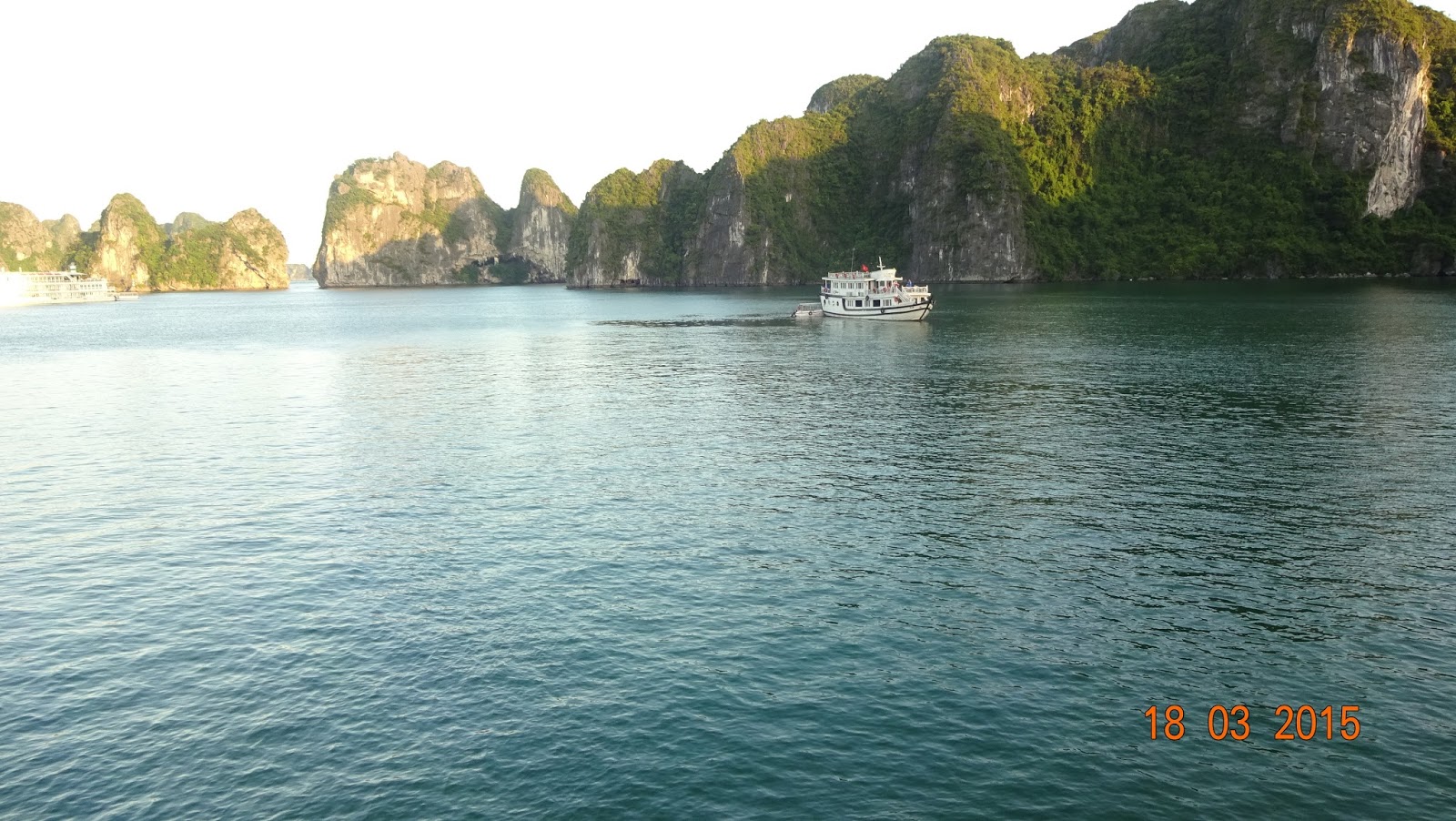
 Hạ
Long Bay, literally: "descending dragon bay"
is a UNESCO World
Heritage Site, and a popular travel
destination, in Quảng
Ninh Province, Vietnam
Hạ
Long Bay, literally: "descending dragon bay"
is a UNESCO World
Heritage Site, and a popular travel
destination, in Quảng
Ninh Province, Vietnam
Hạ
Long Bay has an area of around 1,553 km2, including 1,960–2,000
islets, most of which are limestone. The core of the bay has an area of
334 km2 with a high density of 775 islets.[]The limestone in this bay has gone through 500 million years
of formation in different conditions and environments. In 1994, the core zone
of Hạ Long Bay was listed by UNESCO as a World Heritage Site.
The
bay consists of a dense cluster of some 1,600 limestone monolithic islands each topped with thick jungle
vegetation, rising spectacularly from the ocean. Several of the islands are
hollow, with enormous caves. Hang Đầu Gỗ (Wooden stakes cave) is the largest
grotto in the Hạ Long area.
We
returned to our hotel on afternoon of 1st July, 2015. This was last day and we kept it reserved for
buying some souvenirs.
On 2nd
July, we boarded Thai Air and returned to Delhi in the late evening loaded with
lot of sweet memories.